
By: Tyler Solomon and Nicholas Riggs
Starting in their sophomore and junior years of high school at Marriotts Ridge, teenagers learn to drive in neighborhoods, through rural areas, and on highways. Teens often drive for school, work, or independence. Many lack the experience and knowledge to drive safely, putting themselves and others at high risk due to their lack of experience or youth.
Teenage drivers are at the earliest stages of learning how to operate a vehicle, and they are perceived as having less skill than other drivers on the road. When people first start driving, they will be less experienced, which can also be emphasized by other variables like one’s age and personality.
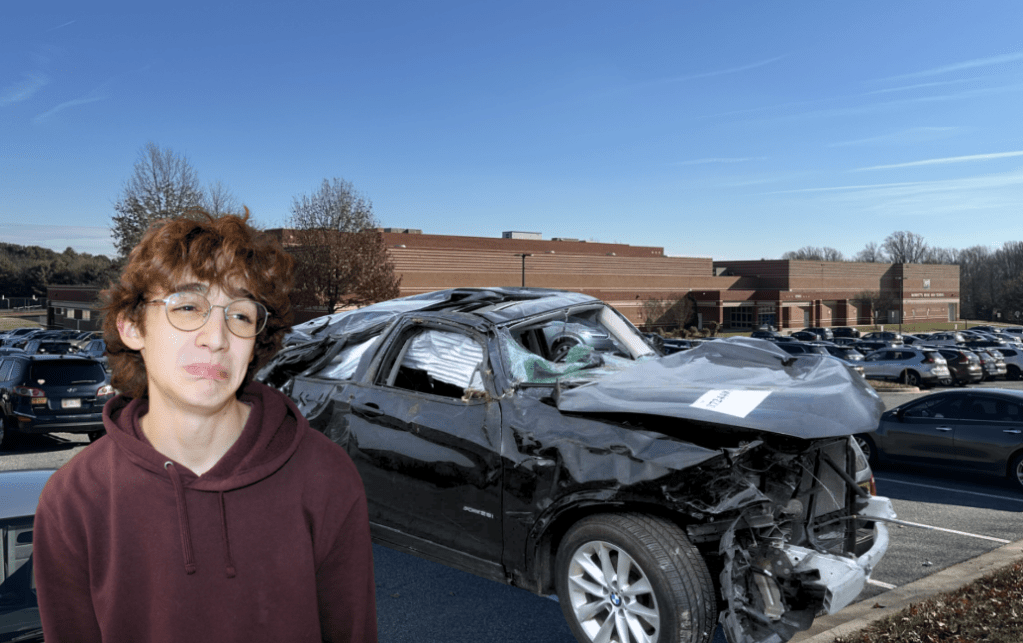
Drivers in the state of Maryland are stereotyped as reckless, and some believe in Howard County’s case, spoiled. Teens hitting the road as soon as they get their license can lead to broken laws. Multiple fancy cars litter the parking lot. Students drive vehicles from upper-end car manufacturers. Teens at Marriotts Ridge have a greater sense of freedom from their newfound licenses or permits, and tend to total their expensive cars or pay fines for violating traffic laws.
“The biggest challenge is [driving to] school because it’s full of new drivers. Everybody’s learning, and nobody’s good,” stated senior Cullen Jenkins.
Another view can also be taken on young drivers. Teenagers are close to adulthood, and it could be argued that they are better drivers due to their newfound knowledge and learning in the rear-view mirror. Additionally, the state of Maryland has strict requirements for obtaining a driver’s license, such as requiring at least 60 hours of vehicle time with a parent, only giving a full license to those 18 or older, and mandating Driver’s Ed. New drivers are required to take ten class sessions and pass a test at the end. Teens might take Driver’s Ed, but they may not pay attention. Teens may be forced into Driver’s Ed, but all they need is to pass and nothing else. Additionally, the process of earning a license can be very monotonous and tedious.
“[Driver’s Ed] is important, but it should be shorter. Most of it is talking about common sense, like how bad it is to drink and drive,” claimed junior Jackson Paige.
Additionally, an important part of one’s driving skills is having a good mentor at the very beginning. If your instructor does not know how to effectively teach basic skills, it’s going to be very difficult to make it past the beginning stages of learning.
“[Parents] affect initial learning. If you have a parent that speeds a lot, you’re going to want to speed a lot,” said Paige.
A parent with good driving skills is arguably the most important foundational piece of learning to drive. Teenagers most likely have known and looked up to family members for almost their entire lives; they’re likely the first person teenagers go to.
Overall, teenage driving can be a very risky skill to develop and hone, whether it be from the teens eager to finally make their way to the road, instructors fearing for their life, or the teenagers who are sensible enough to defy their bad reputation and safely drive.
 NEWS AT MRHS
Leave a comment