
By: Claire Daly
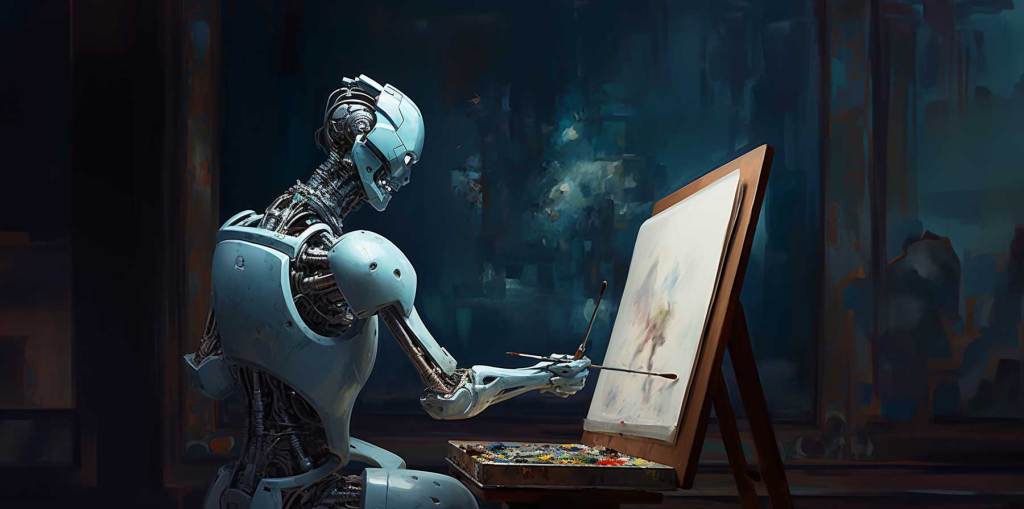
Art has been created by the human hand for millennia, dating back to drawings smeared onto cave walls during the Old Stone Age. As the brush strokes of innovation meet the canvas of code, however, a new predicament has arisen: AI-generated artwork has challenged the art profession, leaving aspiring artists to question the future of their occupation.
In recent years, AI algorithms have become increasingly sophisticated and can generate images that are indistinguishable from human-made work. This technology has led to a growing concern among artists that the use of AI will eliminate the need for their profession. Despite this threat, many art students and staff at MRHS have faith that the technology cannot compete with the authenticity of the human mind.
“I don’t believe AI will lead to the downfall of the art field because it’s about self-expression and, as humans, we always have the need to self-express. I think AI will create visually-attractive images, but humans will have the need to actually communicate something about themselves,” art teacher, Mr. Hensley said.
Unlike humans, AI doesn’t have past experiences that influence what it creates. Van Gogh’s view from his bedroom window at the Saint-Paul-de-Mausole asylum is what inspired him to paint Starry Night. Monet’s early life living in the coastal town La Havre, France, is what sparked his interest in the sea, which later became a significant theme in his work. Their interpretations of their experiences added nuance to their artwork. AI simply runs on a prompt and a send button.
Here at MRHS, students incorporate aspects of their culture, hobbies and interests into their art.
“Last year, I made a piece about classical Indian dance and the history of how it was a male-dominated sport and now it’s a female-dominated sport since I do Indian dance and I’m on the board of the Bollywood Club,” Art 3 AP junior Nevina Abey explained.
Yet, students and artists can still input parts of their personal lives that they want to incorporate into their work into prompts to generate finished pieces. AI is not just used as a tool to create completed images; it can also serve as a valuable inspiration, offering suggestions that the artist might not have considered otherwise. By generating images based on prompts, artificial intelligence can spark imagination and help artists break through creative blocks. This capability has led to a complicated debate over how this technology can be used such that it does not abuse the essence of human expression.
“I’m not an art student, but I think it depends on how the AI is used. If it’s used for inspiration, I think it’s okay as long as it is understood that some artificial intelligence tools, like Ai-da, use stimuli and algorithms to draw based on what it sees in other pieces of art. So it has the risk of plagiarism and it’s not original,” junior Sofie Sun said.
The challenge lies in maintaining a delicate balance between leveraging AI as a creative tool and preventing over-reliance on it. While many want to prevent such technology from taking over the art profession, the task is not so easy.
“It’s hard to enforce the moderation of AI use in art because people are free to do as they please. I believe it’s more important as a society that we acknowledge the value of artists because their value has always been based on their profession and how much they earn, but art is a lot more human than people recognize, which makes it all the more special,” Abey added.
As AI continues to advance, its role in art will only grow more prominent. The key will be finding a balance that allows technology to enhance human creativity without overshadowing it. In the meantime, it is important to appreciate artists for the skill, passion and dedication they bring to their work—the value of art lies not just in its monetary worth, but in the emotion it evokes and the human experience it captures.
So, when walking the halls of MRHS or sitting in the seats of the cafeteria, students should take the time to view the work hanging on the walls of their artistic classmates and be glad, while they still can, that it is human.
 NEWS AT MRHS
Leave a comment