
By: Claire Daly
For many students at MRHS, the familiar theme music of NPR’s All Things Considered brings back memories of sitting in the backseat of a car while their parents listened to the news. What they may not realize is that the voices they hear on WAMU 88.5 during their morning commute are part of that same operation. This summer, I had the opportunity to step behind the scenes at NPR headquarters in Washington, D.C. and meet some of the people who shape the stories that connect our country.
On July 21st, my father and I arrived at NPR headquarters at 3:00 a.m. Michael Lipkin, supervising producer of Morning Edition, greeted us in the lobby and brought us upstairs to the main newsroom. He wore a black shirt with “Boy Wonder” printed on the back in white block letters. He didn’t seem sleepy.
The newsroom was a mix of cubicles, offices, clocks of all shapes and sizes, soundproof studios, and a large segment board mapping out the day’s programming.
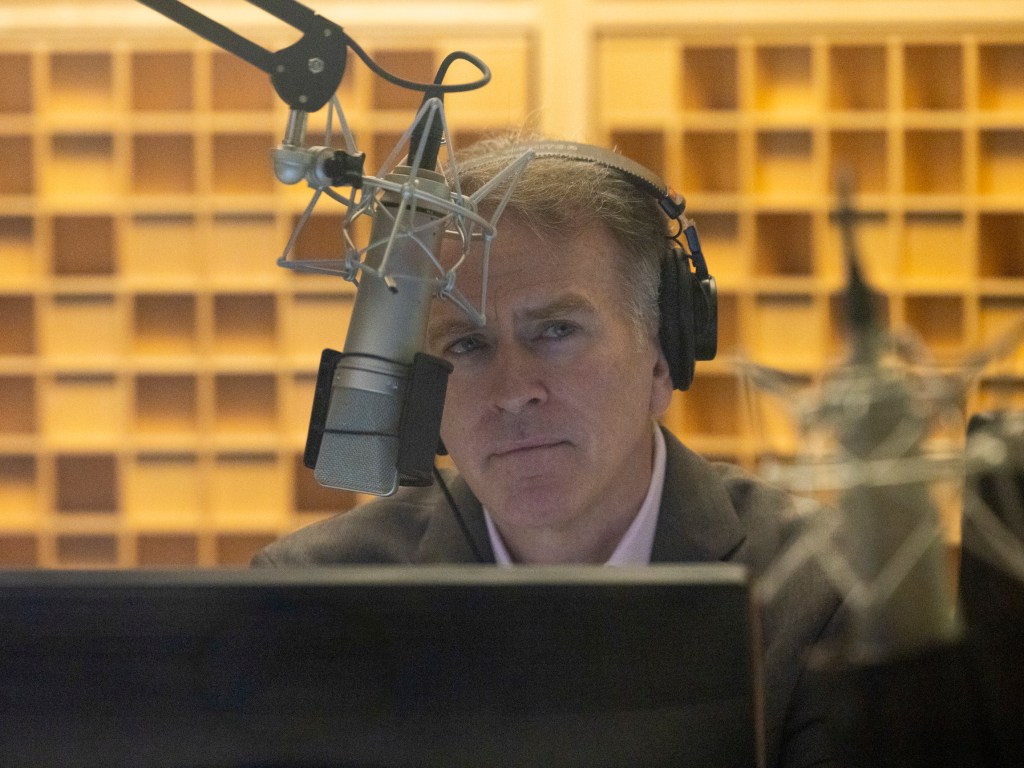
We were taken into a studio where Morning Edition is recorded. The studio was divided into two rooms: one where Lipkin, the show’s director, and a sound technician were surrounded by blinking lights and ticking clocks, and another where the hosts, Steve Inskeep and Sacha Pfeiffer, sat at microphones, recording live-to-tape. (The first two hours of Morning Edition go out live; the second two sound live, but are actually a taped playback.) The two rooms were separated by a large window and connected by microphones, allowing for smooth coordination and communication.
As we sat in the back of the studio, I was amazed by how meticulous the hosts and production team were about language. After each segment, they would review the recording to catch and correct any issues – whether it was a factual error, a cough, a mispronunciation, or even a subtle word choice.
At one point, for example, Inskeep had said, “..[S]ome people seek out yellow jackets, hornets, and wasps…” While waiting between recordings, editors double-checked whether yellow jackets are a type of wasp. After a quick bit of research, they confirmed that they were – and re-recorded the line for accuracy. NPR’s attention to detail, especially when it comes to language–enunciation and facts–is critical in today’s age, when misinformation can spread quickly. It reflects the organization’s mission to provide accurate, thoughtful, and unbiased public service journalism.
About an hour into the show, Inskeep invited us to join him and Pfeiffer in the recording booth. We sat down in front of the microphones, and before the next recording began, I asked them about the importance of precision in their work.
“Most of our listeners are on the road, so they’re not just focusing on what we’re saying – they’re also focusing on driving. A distracted person only hears you one time. That’s why we work so hard to make sure that everything we’re saying is correct,” Inskeep explained.
Once the show wrapped up, we joined Inskeep for breakfast. I asked him what advice he would give to someone whose career depends on connecting with a wide variety of people. Inkseep said, “Almost everyone has an interesting story if you listen well enough. Active listening is an important part of communication.”
On the way home, I kept thinking back to something Inskeep had shared over breakfast. As a young journalist, he went door-to-door interviewing locals in lower-income neighborhoods. Some of the people he spoke with told him that no one had ever asked for their opinion before. He realized that he was playing a role not just as a reporter, but as a bridge – a bridge between people. His job, he explained, is to help people be heard.
What struck me most was how simple, but valuable, his message was: listening matters. Whether it’s through a microphone in a national newsroom or across the table in a school cafeteria, good communication starts with paying attention, asking thoughtful questions, and being open to someone else’s perspective.
For students at MRHS, that might mean listening more carefully to a classmate’s idea during a group project, asking a teacher a follow-up question, or even just putting your phone down long enough to have a real conversation. In a world where it is easy to scroll past someone’s story, maybe the most important thing we can do is stop and listen.


Leave a Reply