
By: Artem Dolgushev
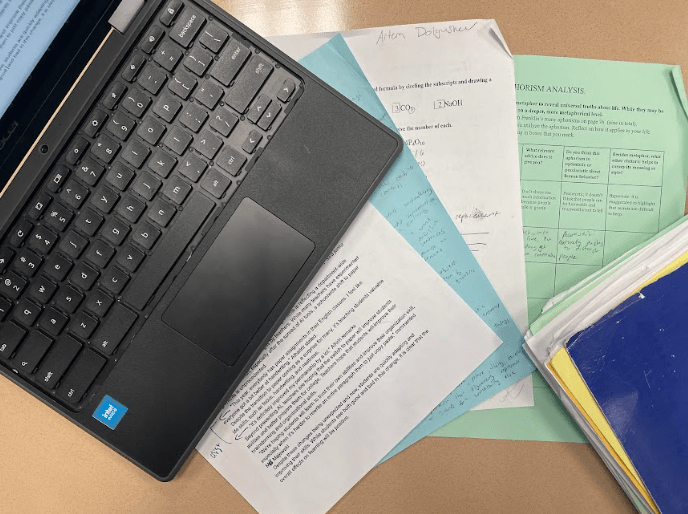
During the COVID lockdown, most school curricula switched to a primarily digital form, and out of convenience, have stayed that way since. However, over the past few months, students have been noticing a sudden shift in classrooms: more handwritten essays, printed worksheets, and in-class paper assignments.
Notably, the primary reason for switching to paper assignments is to prevent the use of AI. Assignments completed on a computer allow not only for the concealment of a phone during the assignment, but also direct entry of the assignment into an AI application.
“I think a big point of why we are on paper is because of what AI can do,” commented junior Colin Daniels.
Teachers had noticed that in the previous years, many students turned in assignments inconsistent with their writing ability.
“There were people turning in writing that obviously wasn’t theirs, which led to the English department as a whole revising the approach to assignments,” English teacher Mrs. Majewski claimed.
In addition to switching to paper assignments, many teachers are also making students complete assignments in class rather than take them home, allowing teachers to supervise the students during their assignments, while also ensuring students work in a distraction-free environment.
This sudden change has caught many students by surprise and has started to affect their academics. For example, students are now having to relearn to write quickly and neatly. Teachers are also facing challenges, as they now have to read each student’s unique handwriting, as messy as it may be.
“My handwriting is kinda sloppy, even I can’t read it sometimes,” said junior Adam Alhariri.
For many students, typing has become a day-to-day aspect that many students are used to, and the switch to handwriting has slowed them down.
“I’m faster at typing than writing, and having to handwrite has slowed me down,” said junior Ryan Sullins.
Unlike previous years, the switch to paper assignments is reflecting a department-wide change, rather than individual changes by teachers. While many teachers have experimented with different forms, especially after the spread of AI tools, a schoolwide shift to paper assignments is unprecedented.
“This year, everybody has paper assignments in their English classes. I feel like everyone got a bit better at handwriting,” stated Alhariri.
Despite the transition to paper coming as a surprise for many, it’s teaching students valuable life skills, such as focus, handwriting, and neatness.
“It’s definitely improved my penmanship by a lot,” remarks Alhariri.
Beyond preventing AI, teachers are hoping that the switch to paper will improve students’ abilities and better prepare them for college. Teachers wish that students would improve their brainstorming and organizational skills.
“We’re hoping students will learn to trust their own abilities and improve their organizational skills, especially when it’s harder to rewrite an entire paragraph than to just copy and paste,” commented English teacher Mrs. Majewski.
Despite these changes being unexpected and new, students are quickly adapting and improving their skills. While these changes are new and may be difficult to adapt to, the overall impact of this change on learning will be positive.


Leave a Reply